

Logic games for kids are great challenges for thinking before acting. We explain the best-known ones, such as the Tower of Hanoi and Tangram, what they practise and how adults can help without giving the answer.
What do logic games practise?
- PlanningThinking before moving and predicting the next step.
- Spatial reasoningImagining how pieces turn and fit.
- Part and wholeSeeing how several pieces make a figure.
- RulesFollowing rules and keeping them in mind.
- PersistenceGetting it wrong, adjusting and trying again.
- Cause and effectSeeing what happens after each move.
As with all games, progress happens mainly in that kind of challenge. There is no guarantee that it transfers to intelligence in general. What remains is the pleasure of solving and the habit of not giving up at the first try.
Tower of Hanoi for kids
The Tower of Hanoi has three bases and several discs of different sizes. The aim is to move the whole tower to another base, with two rules:
- move only one disc at a time;
- never put a bigger disc on top of a smaller one.
With 3 discs, the shortest solution takes 7 moves; with 4 discs, it takes 15. For children, starting with 2 or 3 discs is ideal.
Tip for adults: instead of showing the move, ask «where can the little disc go now?».
Tangram
Tangram is a puzzle of Chinese origin with seven pieces (five triangles, a square and a parallelogram) that together make hundreds of tangram shapes: animals, people, boats. Children practise mental rotation, shape analysis and planning.
Tip: start with figures that show the outline of each piece, then move on to those that show only the silhouette.
How to help without solving it for the child
We recommend that children play games with an available adult — a family member, educator, therapist or another trusted person. Being there makes it possible to share the challenge and offer help when the child asks for it, without taking away the chance to try and choose.
- Ask, don’t show: «What happens if you move that piece?»
- Praise the attempt: «You tried a new idea!»
- Think aloud on your turn: children learn strategies by hearing them.
- Use spatial words: on top, beside, turn, flip, bigger, smaller.
- Know when to stop: a puzzle can wait until tomorrow.
Frequently asked questions about logic games
At what age can children play the Tower of Hanoi?
With 2 or 3 discs, preschool children can understand the rules with help. More discs can come later.
What are the benefits of the Tower of Hanoi?
It is a planning challenge: it asks the child to think before moving, keep two rules in mind at once and predict the next moves. For the child, it is above all a fun puzzle, not a test.
How do you solve the Tower of Hanoi?
With 3 discs, the shortest solution takes 7 moves. A tip: the smallest disc moves every other turn, always in the same direction; on the other turns, only one move is possible. With more discs, the same idea repeats.
Do logic games increase intelligence?
There is no evidence that a game, on its own, increases intelligence. They give practice in planning and spatial reasoning in that kind of task and are excellent challenges.
Physical or digital puzzles?
Physical puzzles let children handle the pieces and play together; digital ones adjust the difficulty and give hints. Combining both is great.
A game score is not an assessment of a child’s abilities. If you are worried about development, talk to their doctor or paediatrician.
Sources
- Skene, K. et al. (2022). Can guidance during play enhance children’s learning and development in educational contexts? Child Development, 93(4). doi:10.1111/cdev.13730
- Yogman, M. et al. (2018). The Power of Play: A Pediatric Role in Enhancing Development in Young Children. Pediatrics, 142(3). doi:10.1542/peds.2018-2058
Keep reading
Vocabulary games for kids
What a word game practises and how to turn it into conversation.
Read the article GuideMemory games for kids
Attention, sequences and patterns, and how to play together.
Read the article GuideBenefits of educational games
What children practise when they play, and what no game can promise.
Read the articleSee the games in action
Explore how Talk+ games work. Choose around the child’s interests; these demonstrations are not treatment recommendations.
See all games →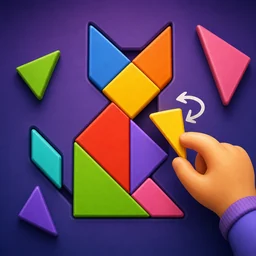 Tangram
 Tower of Hanoi
 Pipe Icons
Published 14 October 2026 · Last reviewed: 14 October 2026
