

Vocabulary games for kids are among the most searched-for games for young children. In this article we explain what research says about learning new words, what a listen-and-choose game actually practises and how to turn it into a conversation.
How do children learn a new word?
Learning a word is more than recognising it once. A child needs to hear it many times, in different situations and linked to something meaningful: the object, the action, the game. Reviews of vocabulary interventions suggest the ingredients matter, such as repetition, linking sound and meaning, and chances to use the word, and that not every approach has the same effect.
It also helps to tell two things apart:
- Understanding the wordHearing «giraffe» and knowing which one is the giraffe. This is receptive language.
- Using the wordSaying, pointing, signing or choosing «giraffe» to communicate. This is expressive language.
A listen-and-choose game mainly practises the first. The second develops through conversation. See Speech, language and communication: what is the difference?.
What does a vocabulary game practise?
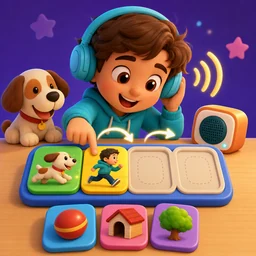
In a «listen and choose» game, the child pays attention to the spoken word, links it to the picture and picks the right picture among similar ones. In faster games, coordination and speed count too: if the child makes a mistake, it may be the movement rather than the word.
A word game can
- Present the same word many times, with picture and voice.
- Vary the context while keeping repetition fun.
- Give a reason to talk about the pictures.
A word game cannot guarantee
- That the child will say the word.
- That they will use it in other situations.
- That a speech delay will resolve.
How to turn the game into a conversation
- Before: «Shall we look for animals? Which animals do you know?»
- During: comment on what appears. «The penguin! It lives where it’s cold.»
- After: «Which one did you like best?» and look for the same words in a book, outside or in the kitchen.
- Swap roles: the child says, points or shows a picture, and the adult searches.
- Choose everyday words the child cares about: food, animals, family, toys, actions.
We recommend that children play with an available adult: a family member, educator, therapist or another trusted person. An adult’s presence is not a condition for playing, and it does not turn the game into an assessment. More ideas in Activities to encourage speech.
Frequently asked questions about vocabulary games
The child gets everything right in the game but doesn’t say the words. Is that normal?
Yes, understanding often comes before speaking. If you are worried about speech, talk to the child’s doctor or paediatrician. See Speech delay.
From what age can children start?
Simple listen-and-tap games can be used with young children, always with an adult and for short spells. See Screen time for kids.
Which words should come first?
Everyday words the child cares about: food, animals, family, toys and actions such as «eat», «sleep» or «more».
A game score is not an assessment of a child’s vocabulary. If you are worried about development, talk to their doctor or paediatrician.
Sources
- Tarvainen et al. (2025). Intervention factors associated with efficacy, when targeting oral language comprehension of children with or at risk for (Developmental) Language Disorder: A meta-analysis. International Journal of Language & Communication Disorders, 60(2). doi:10.1111/1460-6984.70013
- Ansari et al. (2025). Vocabulary interventions for children with developmental language disorder: a systematic review. Frontiers in Psychology, 16. doi:10.3389/fpsyg.2025.1517311
- ASHA. Late Language Emergence — Practice Portal.
Keep reading
Reading games for kids
Syllables, letters, sentences and stories, and how to support early readers.
Read the article GuideBenefits of educational games
What children practise when they play, and what no game can promise.
Read the article Practical ideasActivities to encourage speech
12 simple play ideas for home, and how to talk without pressure.
Read the articleSee the games in action
Explore how Talk+ games work. Choose around the child’s interests; these demonstrations are not treatment recommendations.
See all games →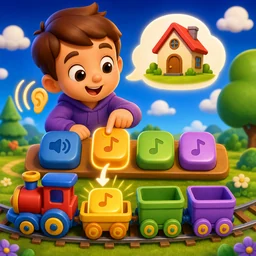 Build Words
 Build Sentences
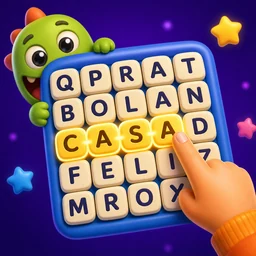 Word Search
Published 14 October 2026 · Last reviewed: 14 October 2026
