

Educational games for kids promise better attention, memory, speech and much more. In this guide we show how to «read» a game, what the main benefits of educational games are and what no game can promise.
How to tell what a game practises
Look at what the game asks the child to do:
| The game asks the child to… | The child mainly practises… |
|---|---|
| Listen and choose | word understanding and auditory and visual attention |
| Remember where something was | visual memory |
| Repeat a sequence | sequential memory and attention |
| Build a figure | spatial reasoning and planning |
| Put words or pictures in order | sentence structure and narrative |
| React at the right moment | coordination and timing |
The same game asks for several of these at once. That is why the score does not tell you which of them the child has mastered, and it is not an assessment.
The main benefits of educational games
Used carefully, a good educational game can offer:
- Words and picturesRepeated exposure to vocabulary, in varied and fun contexts.
- AttentionSearching, comparing and choosing between similar options.
- MemoryHolding on to, recalling and reproducing positions or sequences.
- Problem solvingPlanning, trying, getting it wrong and trying again.
- ConceptsColours, shapes, sizes, numbers, letters and sentences.
- PersistenceShort goals, instant feedback and the joy of succeeding.
And perhaps most important of all: a reason to talk, when an adult plays alongside.
What a game cannot promise
A game can
- Give practice at a type of task.
- Present words with pictures and voice many times.
- Make a challenge fun and repeatable.
A game cannot promise
- That the child will start talking, or that a speech delay will resolve.
- That being better at a memory game improves memory at school.
- That choosing the right picture means the child can say the word.
Skills practised in a game tend to stay close to the task practised. The bridge to real life is built mainly through conversation with adults and other children. A digital game does not replace free play either: see The importance of play.
How to make a game richer
We recommend that children play games with an available adult — a family member, educator, therapist or another trusted person. Playing side by side makes it possible to share attention and talk about what is happening. The adult can comment and give time, without turning every move into a question or requiring the child to speak; gestures, pointing and AAC are communication too. This recommendation does not mean the child has to wait for an adult before they can play.
- Play alongside and comment: «You found the elephant! It’s huge!»
- Ask the child to teach you the game. Explaining is language practice too.
- Take the game off the screen: look for the same things at home, draw them, talk about what happened.
- Respect breaks and refusals. Tiredness and frustration do not teach.
Types of educational games
- Memory and attention games: remember, follow and compare.
- Logic games and puzzles: plan and solve.
- Word games: listen, look and choose. See how to turn them into conversation.
Frequently asked questions about educational games
Are educational games better than toys?
They are neither better nor worse, just different. Free play with objects and people is still essential.
Can a young child play on their own?
We recommend playing with an available adult, mainly to share the experience and create chances to talk. An adult’s presence is not a condition for accessing the game and does not turn the activity into an assessment.
How can I tell if a game is suitable?
The child understands the goal, enjoys it, gets it right some of the time and wants to try again. Choose games with no ads, and be wary of any that promise health outcomes.
What are good educational games for 3-year-olds?
Short games with few options at a time, clear pictures and voice, where the child understands the goal without reading. Hearing a name and choosing the picture, finding pairs with a few cards or simple puzzles are good starting points. Play alongside the child.
A game score is not an assessment. If you are worried about a child’s development, talk to their doctor or paediatrician.
Sources
- Skene, K. et al. (2022). Can guidance during play enhance children’s learning and development in educational contexts? A systematic review and meta-analysis. Child Development, 93(4). doi:10.1111/cdev.13730
- Lillard, A. S. et al. (2013). The impact of pretend play on children’s development: A review of the evidence. Psychological Bulletin, 139(1). doi:10.1037/a0029321
- Yogman, M. et al. (2018). The Power of Play: A Pediatric Role in Enhancing Development in Young Children. Pediatrics, 142(3). doi:10.1542/peds.2018-2058
Keep reading
Memory games for kids
Attention, sequences and patterns, and how to play together.
Read the article GuideLogic games for kids
Tower of Hanoi, Tangram and puzzles: plan and solve.
Read the article GuideThe importance of play in child development
What the research says, the kinds of play and the adult’s role.
Read the articleSee the games in action
Explore how Talk+ games work. Choose around the child’s interests; these demonstrations are not treatment recommendations.
See all games →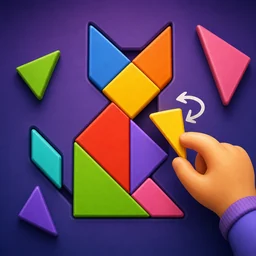 Tangram
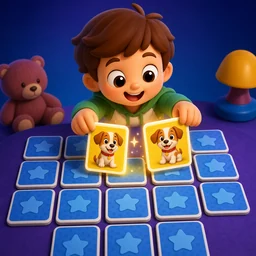 Memory Match
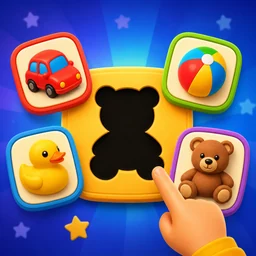 Choose the Picture
Published 14 October 2026 · Last reviewed: 14 October 2026
