

The basis for these suggestions
Somerset’s children’s therapy service includes visual memory among perceptual skills and suggests recall and matching games. Performance also depends on seeing the materials clearly, understanding them and attending. Difficulty on a board does not describe the child’s entire memory.
This guide distinguishes observation, recalling a missing item and remembering positions. These are adaptable examples, not standardised tests. Improvement with a familiar set may reflect learning its pieces and rules; it does not itself demonstrate gains in reading or general memory.
References for this background: Somerset NHS Foundation Trust — Visual perceptual skills · Humber Teaching NHS Foundation Trust — Auditory Processing and Memory Games.
Three ideas to try
The activities below are educational examples created for this article, informed by the source principles. They are not a validated intervention programme. Choose one, demonstrate it and allow the child to try, ask for help, take a break or stop.
- The missing objectShow three large familiar objects and name them if helpful. Cover them, remove one and find what is missing. Offer two visible choices if needed.
- Where was it?Use two pairs of simple drawings. Look at positions before turning cards over and find one pair at a time. Add cards only if the child wants and can follow.
- A tiny constructionMake a sequence of two distinguishable coloured blocks. Observe, hide and rebuild it. Start with the model visible if needed, explaining that this changes the task.
Making the activity accessible
Provide contrast, large pieces and an uncluttered surface. Add shape or texture when colours are hard to distinguish. Pointing or selecting can replace naming. Seek individual access advice for low vision; a tactile task is not an equivalent visual memory test.
Notice what made participation easier: fewer items, a demonstration or a gesture response. Return to that version before increasing difficulty. Compare with the child’s own previous experience rather than ranking children.
When to seek advice
Discuss persistent difficulties finding materials, copying or recognising elements with school and relevant professionals. If reduced vision is suspected, arrange a vision assessment rather than assume more memory practice is needed.
What we can conclude
What we can say
- A game can offer practice recalling the particular elements and positions presented.
What we cannot say
- Scores do not measure intelligence, diagnose visual difficulties or guarantee school improvement.
Information only. This does not replace individual assessment or advice from health and education professionals. Activities are adaptable suggestions; a game score is not a developmental assessment.
Frequently asked questions
Is spotting differences visual memory?
It may involve memory, but simultaneous pictures mainly require comparison and discrimination.
Must the child name each object?
No. Pointing or selecting allows a choice without an additional speech demand.
Are more cards always better?
No. A smaller set may enable strategies and enjoyable participation.
Will games improve memory everywhere?
Performance on one task does not automatically demonstrate transfer to other contexts.
This article is for information only and does not replace an assessment by a health professional. If you are worried about a child’s development, talk to their doctor or paediatrician.
Sources
Keep reading
Auditory memory games: words and instructions
Auditory memory games with familiar words and short instructions. Separate hearing, understanding and recall, while keeping useful visual support.
Read the article GuideMemory games for kids
Attention, sequences and patterns, and how to play together.
Read the article GuideSustained attention games for children
Sustained attention games for children with clear endings, short rounds, movement and accessible adaptations rather than timed comparisons.
Read the articleSee the games in action
Explore how Talk+ games work. Choose around the child’s interests; these demonstrations are not treatment recommendations.
See all games →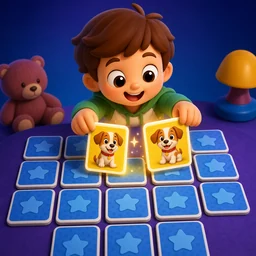 Memory Match
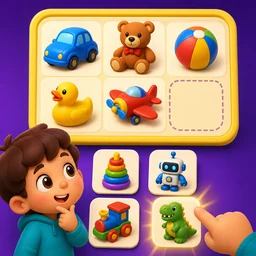 What's Missing?
 Follow the Lights
Published 9 November 2026 · Last reviewed: 9 November 2026
